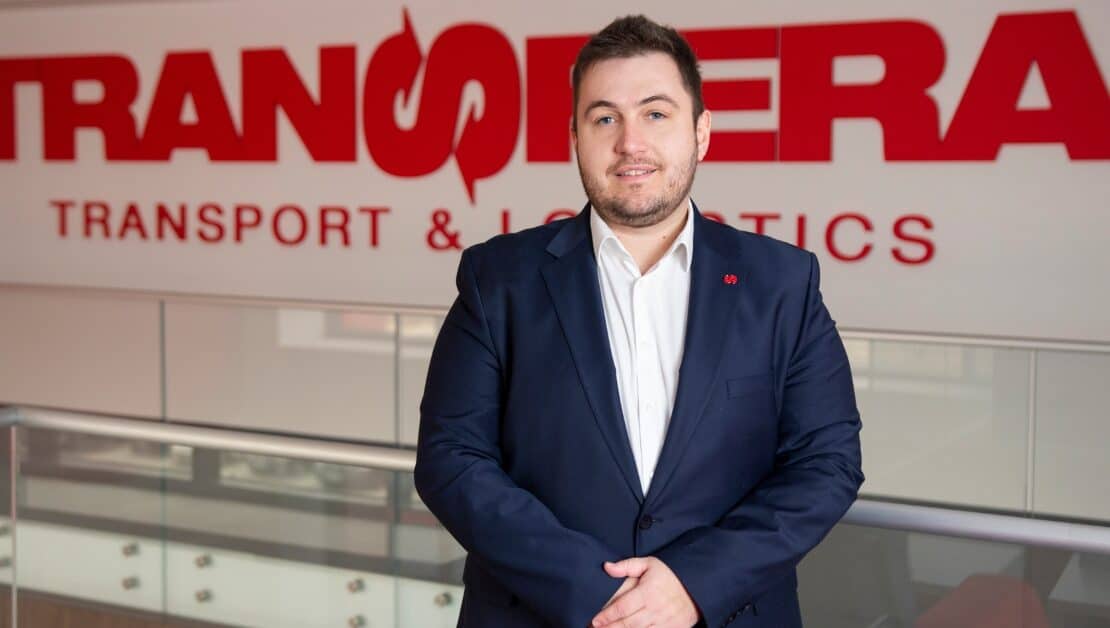
Marko Rizov, Road Transport Director at Transfera –
“Leaders in the future will be those who today fuse innovation with knowledge and real-world application.”
At a time when global logistics is evolving faster than ever, Serbian transport and logistics company Transfera has positioned itself as one of the regional market leaders, recognized for its innovation, digital transformation, and focus on people development. Marko Rizov, Transfera’s Director of Road Transport, has been part of the industry since the days when Serbia was just starting to catch up with Europe. Today, through innovation, digital transformation, and the Transfera Talent Academy, he is building systems and teams that set new benchmarks. In this interview for InStore, Marko discusses the industry’s biggest challenges, shifting client demands, the key technologies and innovations shaping the future of logistics, and shares personal experiences that have defined his professional journey.
1. What are the biggest challenges the logistics industry is facing today?
Logistics operates in an extremely dynamic environment that demands constant adaptability. Among the biggest challenges are geopolitical conflicts, which complicate or even prevent transportation to or through affected areas, forcing us to design alternative routes and create new logistics solutions. Globally, the industry is undergoing rapid digital transformation, including the rollout of ICS2 and NCTS5 systems, aimed at improving cross-border goods movement an area we are heavily investing in by developing our IT sector. At the same time, rising costs, unpredictable fuel prices, and inflation make it difficult to balance client expectations with market realities. Deadlines are shorter, demands are more frequent, and standards are stricter — from customs regulations to green solutions. In such circumstances, success depends on our ability to respond quickly, to truly listen to client needs, and to keep investing in our most valuable asset — our people and their knowledge.
2. Have you noticed significant changes in client and consumer demands? How are you adapting?
The rise of online shopping has completely reshaped expectations. Today, the end customer wants to place an order from the comfort of their home, receive it as quickly as possible, and have full transparency in tracking their shipments. This created a need for specialized e-commerce solutions, an area where Transfera has become a regional pioneer. We developed a dedicated department that integrates transport, customs clearance, warehousing, sorting, and express delivery. Today, in partnership with leading global platforms, we deliver up to 50,000 packages daily. Additionally, the global crisis has led to shipment downsizing instead of large orders, smaller, more frequent shipments have become the norm, yet with the same transit times and quality standards. Our response has been to form a specialized team and deepen integration with our partners, allowing us to remain both efficient and flexible.
3. Which technologies currently have the biggest impact on logistics?
The technologies shaping logistics today are the ones helping us work smarter, faster, and with greater precision particularly in road transport. The core of this change is artificial intelligence, which allows more accurate delivery time estimates, route optimization, and early detection of potential issues. Robotic automation is improving warehouse efficiency, while cloud and edge computing enable instant data access and real-time team synchronization. I would also highlight Big Data and BI tools, which allow us to turn all these technologies into actionable insights that ultimately help us make smarter decisions, reduce delays, and enhance service quality.
We have embraced all these innovations because they are no longer the future they are essential tools for staying competitive today.
4. How does your company integrate digitalization and automation into its processes?
Our approach combines in-house development with smart integration of external systems. Internally, we develop software solutions for shipment management, scanning, routing, and real-time two-way communication with partners, while also using AI for package classification, risk assessment, and automated reporting. Through APIs and webhook integrations, we connect with customs platforms, e-commerce portals, and courier services. Additionally, we use Power BI and data warehouses to track performance and make data-driven decisions. In practice, this results in greater accuracy, better process control, and more time for strategic growth.
5. Do you believe the human factor will always remain crucial in logistics, regardless of the level of automation? If so, why?
While technology is increasingly shaping modern logistics, the human factor will always remain its cornerstone. Automation and digital tools make processes faster and easier, but no system works without the people behind it. At Transfera, over 550 employees make key operational and strategic decisions every day, solve challenges on the ground, and maintain relationships with clients. From IT specialists and customs officers to planning and operations support teams, everyone plays an irreplaceable role in building a stable, reliable, and flexible logistics system. Technology enables us to be faster and more precise, but it’s the people who make the difference. That’s why I believe the future of logistics lies in the smart combination of innovation and human expertise.
6. How much of a priority is sustainability in your operations, and what steps are you taking toward greener solutions?
At Transfera, we are proud to integrate sustainable practices into every segment of the logistics chain. We place special emphasis on intermodal transport as a strategic direction, which involves shifting transport units from road to rail, directly reducing CO₂ emissions and increasing efficiency. Our fleet uses Euro 6 engines, while additional fuel savings and emission reductions are achieved through ECO-driving training for drivers and the use of TIR parking facilities within our complex. In our warehouses, we use LED lighting, recyclable materials, and more than 100 electric forklifts — a quarter of which are powered by LION technology. Solar panels are also being installed on the roof of our central logistics facility. All these initiatives are implemented as we are convinced that sustainability is not an option, but a responsibility toward our partners, our community, and the environment in which we operate.
7. Where do you see the logistics industry in 5 to 10 years? What key innovations do you think will shape its future?
Given the rapid development of technology and artificial intelligence, I’m convinced we are on the brink of a new era in logistics. We’ll see wider use of autonomous vehicles for long-haul routes and drones delivering packages directly to doorsteps, making deliveries faster, simpler, and more affordable. Artificial intelligence will become our everyday ally — from demand forecasting and route optimization to warehouse automation and precise inventory management. However, technology itself is not the ultimate goal. Its true value will be in making work easier, helping companies grow, and providing end users with a delivery experience unlike anything we’ve known before. The leaders of the future will be those who are already blending innovation with knowledge and the ability to apply it effectively.
8. What personally drew you to this industry?
While I was still at university, my professors encouraged me to consider a career in logistics because, back in 2010, it was still a very young industry in Serbia. Compared to Europe, we were far behind; modern logistics solutions hardly existed, and supply chains were just starting to take shape. What fascinated me was how, in developed systems, everything worked seamlessly — someone would create a plan, set up a process, and it would run flawlessly, whether it involved trains, trucks, or complex transport networks. That fascination led me to the Faculty of Transport and Traffic Engineering, and later to a career dedicated to this industry. Now, 15 years later, I’m proud to see that logistics in Serbia is on par with Europe — perhaps more so than any other sector of our economy.